
In this guide
An estimate is your best guess at the price, and it can change if the job turns out different from what you expected. A quote is a fixed price for a defined scope, and it holds unless the scope changes. A bid is a price you submit to win a job against other contractors, usually from plans someone else drew up. Clients use the three words loosely, and so do most tradespeople, which is exactly how "but you quoted me $8,000" arguments start.
Side by side
| Estimate | Quote | Bid | |
|---|---|---|---|
| How firm is the price | Can move, within reason | Fixed for the stated scope | Fixed, often per the bid documents |
| Typical use | Repairs and remodels with unknowns | Well-defined work you have done many times | Commercial and public jobs, GC subcontracts |
| Who defines the scope | You | You | The owner, architect or GC |
| What changes the price | New information (what's behind the wall) | A change in scope, via a change order | A change order under the contract |
| Competing against others | Sometimes | Sometimes | Always |
A proposal is a fourth word you'll see. It usually means an estimate or quote dressed up with a scope description, terms and a signature line. The name matters less than what's written in it.
Why the word on the top isn't what protects you
If a dispute ever gets serious, what counts is what the document says and what both sides agreed to, not whether the top of the page said ESTIMATE or QUOTE. A document titled "estimate" that lists a single price with no conditions reads a lot like a fixed quote. A "quote" that lists its assumptions can still change when those assumptions turn out wrong.
So whatever you call it, write down:
- The scope, specifically. "Replace 40 ft of fence, 6 ft cedar privacy, reuse existing posts where sound" rather than "fence repair".
- What it assumes. "Assumes existing posts are sound. Replacement posts $95 each if needed." This one line is the difference between a fair extra charge and a broken promise.
- What it excludes. Permits, haul-away, paint, anything a client might reasonably think is included.
- How long the price is good for. Thirty days is common. Material prices move, and a price from last spring can lose you money this fall.
Which one to give
Give an estimate when you can't see everything: remodels, repairs, anything behind drywall or under a floor. Say clearly that it's an estimate, and give the range or the conditions that would move it.
Give a quote when you've done the job enough times to know what it takes, like a water heater swap, a panel change, or a standard-size roof. Clients like a fixed number, and it's often how you win against a vaguer competitor. Just make sure the scope is written tightly enough that "while you're here, could you..." is clearly extra.
Submit a bid when the owner or GC has already defined the work and wants comparable prices. Read the bid documents carefully. On public work, bids are usually sealed, opened at a set time, and very hard to withdraw once opened, so a math mistake can bind you.
A worked example: the same job, three ways
A homeowner wants a bathroom exhaust fan replaced with a larger one that vents outside instead of into the attic.
- As an estimate: "$650 to $900. The range depends on the attic route to the exterior wall. Final price confirmed after inspecting the attic." Honest, and it protects you, but some clients will call three more contractors to get a single number.
- As a quote: "$780, fixed. Includes 110 CFM fan, up to 12 ft of insulated duct to a new wall cap, patching the ceiling around the new housing. Excludes painting. If the joists run the wrong way for the new housing, framing is extra at $85/hour." Firm, still protected.
- As a bid (if a property manager sent a spec for 12 units): the price per unit exactly as their spec asks, with the exclusions their form allows and nothing else.
The quote version usually wins the job. It took five minutes longer to write.
Getting from any of them to an invoice
However you priced it, the invoice should mirror the accepted estimate or quote line for line, with approved changes added as dated lines. The client checks the two against each other. The contractor estimate template has a valid-until date and a notes box set up for assumptions and exclusions, and there are versions for electricians, plumbers, HVAC and other trades.
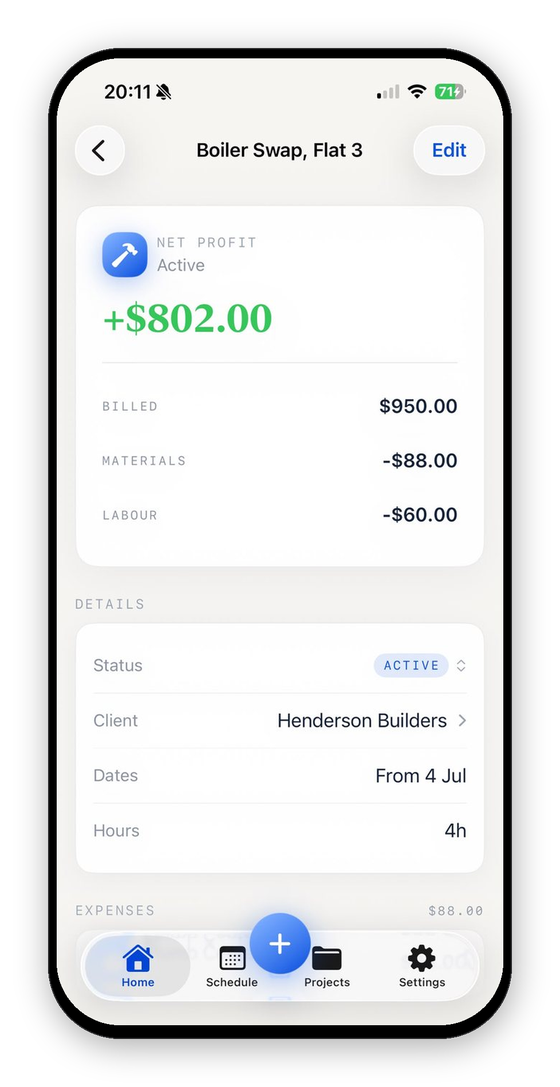
In VanReceipts you can snap a photo or describe the job in a voice note, and cloud AI drafts the line items. You check every line, add your assumptions, and send it. When the client accepts, it becomes the invoice in one tap.
If you want to see where an AI draft helps and where it guesses, read what AI estimating gets right, and what you still check. For the price underneath any of the three, the trade guides show the math for electrical work, plumbing and handyman jobs.
For a fixed price with an acceptance line, start from the free quote template. For work a property manager sends you, the work order template carries the PO number and not-to-exceed amount.
What did that job really make?Profit and margin for any job in seconds.FAQ
Is an estimate legally binding?
Usually an estimate on its own is treated as an approximation, not a promise to do the work for exactly that price. That changes if its wording makes it read like a fixed price, or if it's signed as the contract. Many states also have home improvement laws requiring a written contract with specific terms before work starts. If a job is large, have your contract reviewed once and reuse it.
Can a contractor charge more than the quote?
Only for work outside the quoted scope, or if the quote's own conditions allow it (like the joist example above). That's why the scope and assumptions need to be in writing. Extra work should go through a written change order the client approves before you do it.
How long should a quote be valid?
Thirty days is the most common window. Use a shorter one for material-heavy work when prices are moving, and put the date on the document rather than a number of days.