
In this guide
An invoice needs eight things: your business name and contact details, the client's name and address, a unique invoice number, the date, a due date, the work itemized with prices, the total with any tax shown on its own line, and how to pay you. Get those right and the invoice does its job. What separates an invoice that gets paid this week from one that sits in someone's inbox is mostly how the work is described and how easy it is to pay.
A real example
Here is a finished invoice for a two-day deck repair. It is the kind of job where an unclear invoice leads to a phone call asking what "labor, $1,020" covers.
| Description | Qty | Rate | Amount |
|---|---|---|---|
| Remove and dispose of 6 rotted deck boards and 2 joists | 1 | $240.00 | $240.00 |
| Sister 2 joists with 2x8 pressure-treated lumber, labor (hours) | 5 | $85.00 | $425.00 |
| Install new composite deck boards, labor (hours) | 7 | $85.00 | $595.00 |
| Composite boards, hidden fasteners, joist tape | 1 | $486.50 | $486.50 |
| Replace loose stair stringer, including hardware | 1 | $210.00 | $210.00 |
| Subtotal | $1,956.50 |
Above the table go the header details: Invoice INV-0142, issued June 12, due June 26, the business name and phone, and Bill to: Dana Ruiz, 18 Alder Court. Below it: Pay by card from the link in this email, or by check to the address above.
Three things make this one easy to pay:
- Each line is a thing the client saw happen. They watched the old boards come off and the stair get fixed. Nothing on the list is a mystery.
- Labor shows hours times rate. Twelve hours at $85 is easy to check against two days on site. A single $1,020 labor line is not.
- Materials are one line, not twenty. The client doesn't need every screw. They need to see that materials were real and roughly what they cost. Keep the supplier receipts in case they ask.
The header details, and what trips people up
- Invoice number
- Sequential and never reused. It is how you and your client refer to this bill, and how your bookkeeping stays straight. INV-0142 is fine, and so is 2026-042. Pick a format and stick to it. More on this in what an invoice number is for.
- Issue date and due date
- Write the actual due date ("due June 26"), not just "Net 14". A client paying bills on a Sunday night should not have to count days.
- Your details
- Business name, phone, email, and your license number if your trade and state require one. For contractors in some states the license number is required on contracts and bids, and putting it on invoices keeps everything consistent.
- The client's details
- Their name and billing address, and the job address if it's different. Property managers and landlords often pay from a different address than the one you worked at.
Tax
If you charge sales tax, show it as its own line with the rate: "Sales tax 6.25% on materials: $30.41." Don't fold it into the prices. Whether trade services are taxable is decided state by state, and in many states the answer differs between materials and labor, so check your state's department of revenue once and set your invoices up to match.
How to send it
Send it the day the job is done. The work is fresh, the client is happy with it, and the invoice arrives while they still remember why they're paying. An invoice sent two weeks later competes with everything else they've bought since.
Email or text a PDF, or better, a link they can pay from. Every extra step between reading the invoice and paying it (finding a checkbook, logging into a bank to set up a transfer) adds days. A "pay by card" link removes most of them, and the card fee is usually cheaper than waiting a month for your money.
If you want to try it on a real job, the free invoice generator makes a PDF like the one above, and there are ready-filled versions for contractors, electricians, plumbers and other trades.
When the invoice comes from an estimate
If you gave the client an estimate first, the invoice should use the same lines in the same order, with any approved changes added as their own lines and dated. The client compares the two side by side, even if they don't say so. Matching lines are the quickest way to show the final price is the price they agreed to. (In VanReceipts the estimate turns into the invoice with one tap, so the lines match without retyping.)
If the job started with a drafted estimate, AI estimating for contractors covers what to check before the numbers reach the invoice. And if a client asks whether this is their receipt, invoice vs receipt explains the difference.
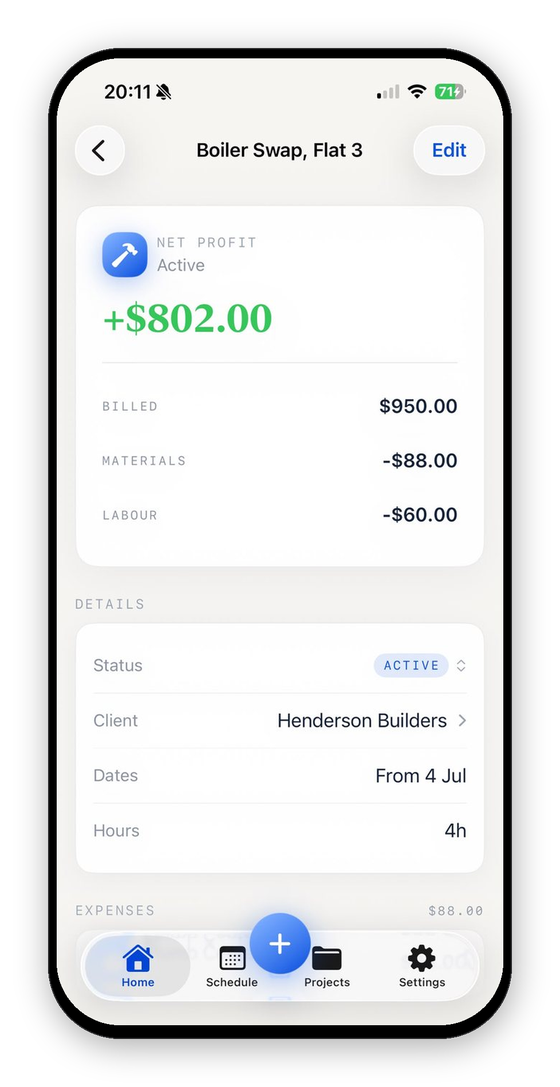
What did that job really make?Profit and margin for any job in seconds.FAQ
Can I write an invoice by hand?
Yes. No US law requires invoices to be typed, and a handwritten invoice with all eight details is valid. The drawbacks are practical: it's harder to keep numbers sequential, harder to send, and your copy is easy to lose.
Do I need a registered business to send an invoice?
No. Sole proprietors and freelancers invoice under their own name all the time. Use your legal name, or a registered trade name if you have one, and report the income on your tax return.
What is the difference between an invoice and a bill?
They are the same document seen from two sides. You send an invoice. Your client receives a bill. An invoice is also different from a receipt, which confirms a payment was made. See invoice vs receipt.
Should I charge for materials at cost?
Most trades mark materials up to cover the supply run, the time to order and pick up, and the risk of returns. Show materials at your selling price on the invoice and keep your cost in your own records.