
In this guide
Handyman work loses money in the gaps: the twenty-minute job that took two hours door to door, the extra task done "while I'm here" for nothing, the trip back for a part. Pricing that works for a handyman has three pieces: a minimum charge that pays for showing up, a list of task prices you've timed, and an hourly rate for everything that doesn't fit the list.
Start with the minimum charge
A small job costs the same drive as a big one. Say the client is 25 minutes away, and setup and cleanup take 15 minutes. That's 65 minutes of your time before you touch the job. At a billable rate of $75 an hour, that's $81 spent just arriving and leaving.
So a minimum charge of $125, covering the first hour on site, isn't padding. It's what makes the ten-minute faucet cartridge swap worth doing. Put it on every estimate and invoice as its own line, so the client reads it as a policy and not a surprise.
Price the tasks you do every week
Keep a list of your common jobs with the time each one really takes you, not the time you'd like it to take. Then price each one:
Task price = your time × your billable rate + materials with markup
| Task | Your time | At $75/hr | Materials, marked up | Price |
|---|---|---|---|---|
| Mount a TV, cables in the wall | 1.5 hr | $112.50 | $35 | $150 |
| Rehang a sticking interior door | 1 hr | $75.00 | none | $75 |
| Patch and paint three drywall holes | 1.5 hr | $112.50 | $20 | $135 |
| Install a grab bar into studs | 1 hr | $75.00 | $45 | $120 |
Rounded, and written as a price per task, this becomes an estimate the client can trim to fit a budget, and a record of which jobs you keep underpricing. If grab bars keep taking two hours, change the list.
Set your hourly rate from your costs
"Handyman rates" in your area tell you what clients are used to. They don't tell you what your business needs. Work it out:
- What you want to earn a year, as if you paid yourself a wage.
- Plus your costs: self-employment tax (15.3 percent on most net earnings), insurance, the truck, tools, phone and software.
- Divided by the hours you can actually bill. For most handymen that's 25 to 30 a week, not 40, once you take out driving, estimates and supply runs.
The labor cost calculator does this. People are often surprised how far above their take-home wage the answer is. That gap isn't profit. It's the part of the week nobody pays for.
Watch the license threshold
Many states limit how large a job an unlicensed handyman can take. In California it's $1,000 per job, labor and materials together, and the CSLB doesn't allow splitting a job across invoices to stay under it. Other states set their own limits or require registration. Know yours before you quote anything bigger than a punch list.
Put it in writing, even for small jobs
A one-page estimate with the tasks, the minimum charge and your rate for extras ("additional tasks on the day at $75 an hour") prevents most arguments. The handyman estimate template is set up exactly this way, and the handyman invoice template carries the same lines through to the bill.
A task list priced this way also makes a quick estimate. VanReceipts can draft one from a photo or a voice note, and AI estimating for contractors covers what to check before it goes out.
Your costs include the deductions you can take against them. Self-employed contractor tax deductions lists what a handyman business can write off.
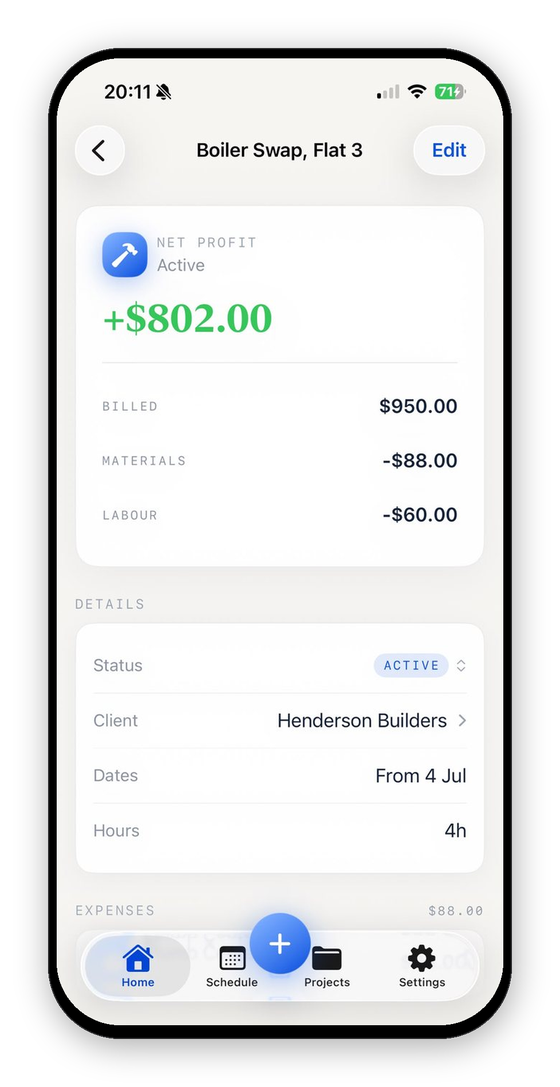
What did that job really make?Profit and margin for any job in seconds.FAQ
Should a handyman charge by the hour or by the job?
Both. A flat price for tasks you've timed, and hourly for open-ended work. Clients like knowing the price up front, and flat prices reward you for getting faster.
Is a minimum charge normal for handyman work?
Yes. Most handymen charge a minimum or a trip fee, often covering the first hour. It covers the drive and setup that every job needs, however small.
How do I handle "while you're here" requests?
Agree a rate for extra tasks on the estimate. Then you can say yes on the spot, and the invoice shows it as its own line.