
In short
A write off is a legitimate cost of running your business, subtracted from your income before tax. For a self-employed contractor that means tools, materials, subcontractor pay, vehicle costs, insurance, licenses, and more, tracked as you spend, not guessed at in April.
In this guide
Not tax advice. This is a plain-English map of what usually qualifies for a self-employed contractor; a tax preparer can confirm what applies to your situation.
What a Tax Write Off Actually Is
A tax write off, also called a deduction, is money you spent running your business that the IRS lets you subtract from your income before you calculate what you owe. It is not a discount, and it is not free money. If you spend $500 on a tool and you are in a 22 percent bracket, the write off saves you roughly $110 in tax, not $500. It still matters, because it is the difference between paying tax on your revenue and paying tax on your actual profit, which is the number that should be taxed in the first place.
The Real List for a Self-Employed Contractor
Most of what a solo tradesperson spends money on to do the work falls into one of these categories:
| Category | Examples |
|---|---|
| Tools and equipment | Power tools, hand tools, ladders, safety gear |
| Materials and supplies | Anything bought for a specific job and billed through it |
| Subcontractor and helper pay | Anyone you paid to help on a job who is not your W-2 employee |
| Vehicle costs | Mileage or actual vehicle expenses, see the 2026 mileage rate |
| Insurance | Liability, tools and equipment, vehicle |
| Licenses and permits | Trade licenses, business permits, continuing education required to keep them |
| Phone and software | The business-use share of your phone bill, invoicing or scheduling apps |
| Marketing | Business cards, a website, local ads, signage on your van |
| Bank and processing fees | Business account fees, card processing fees on invoices |
| Home office | A dedicated space used regularly and only for business, a narrower rule than most people expect |
Materials and subcontractor pay are the two biggest categories by dollar amount for most trades, and also the two most likely to be under-tracked, because they get paid for at the moment and forgotten by tax time.
The Rule That Decides If Something Qualifies
The IRS standard is that a business expense has to be ordinary and necessary: ordinary meaning common in your trade, necessary meaning helpful and appropriate for running it. A ladder is obviously ordinary and necessary for a painter. A truck bed toolbox is ordinary and necessary for most trades. A cost that is really personal, dressed up as business, is the one that gets an audit its own attention.
Where These Show Up on Your Return
For a sole proprietor, these deductions flow through Schedule C, which is the form that turns your gross income into a net profit figure before it hits your 1040. Materials might land under supplies, subcontractor pay under contract labor, tools under supplies or depreciation depending on the cost, and so on. The category names on the form do not always match how a tradesperson thinks about spending, which is exactly why so many legitimate write offs get missed. The full walkthrough is in Schedule C deductions for self-employed contractors.
Why Guessing at Write Offs in April Costs You Money
The write offs that get missed are almost never the big ones. Nobody forgets a $4,000 tool purchase. What gets missed is the $40 hardware store run in March, the $18 permit fee from a job in June, the parking you paid at a client's building in September. Individually small, and there are dozens of them across a year. Reconstructing that list from memory in April means most of it never gets claimed, which means you paid tax on money you did not actually keep.
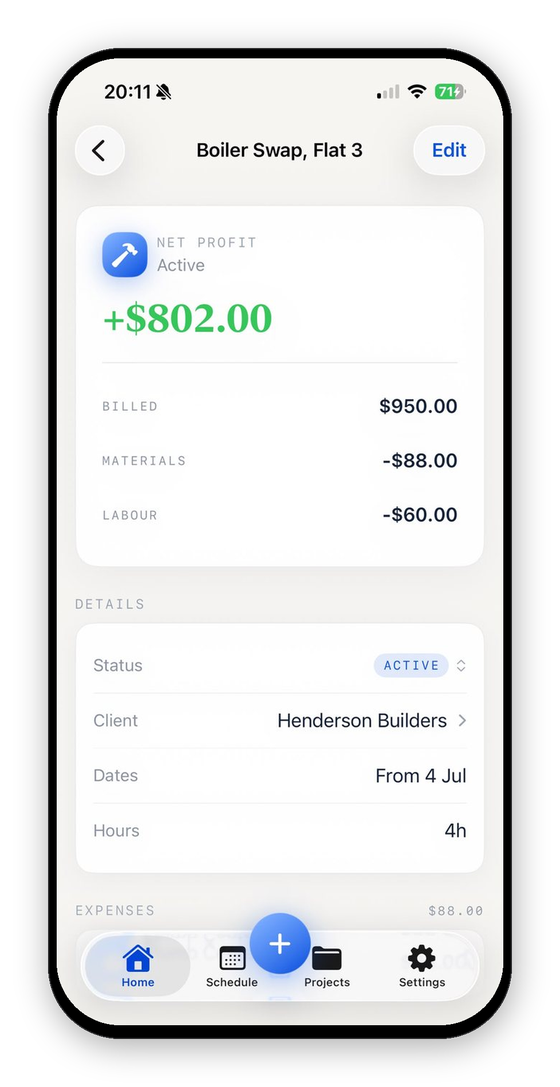
The fix is not a better memory, it is capturing the cost the moment it happens and attaching it to the job it was for. A receipt scan does that in the time it takes to take the photo, and if it is already tagged to a job, it doubles as your job costing at the same time as your tax record.
If you pay yourself a wage in your head, the labor cost calculator shows the hourly rate that covers it, self-employment tax included.
What did that job really make?Profit and margin for any job in seconds.FAQ
What is a tax write off in simple terms?
A cost of running your business that the IRS lets you subtract from your income before you are taxed. It reduces your taxable profit, not your tax bill directly, so the savings are your tax rate times the deduction, not the full amount.
What can a self-employed contractor deduct?
Tools and equipment, materials and supplies bought for jobs, subcontractor and helper pay, vehicle costs, insurance, licenses and permits, business phone and software, marketing, and a business-use share of a genuine home office.
Is a business write off the same as a tax credit?
No. A write off reduces the income you are taxed on. A credit reduces the tax bill itself, dollar for dollar. Most contractor expenses are write offs, not credits.
How do I know if an expense is deductible?
The IRS standard is "ordinary and necessary": common in your trade, and helpful and appropriate for running your business. A tool, a permit fee, or job materials clearly qualify. Anything mixing personal and business use needs the business-use share worked out.
Download VanReceipts on the App Store and scan every receipt as it happens, tagged to the job.