
In short
Build your diagnostic fee from six real costs, and build your hourly rate from overhead plus billable hours, not a number copied off a competitor. In the worked example below a $129 flat fee barely covers the visit before a single callback happens.
In this guide
- Why a Flat Fee Is a Guess Until You Cost It
- What Actually Sits Inside One Service Call
- Building the Diagnostic Fee From the Cost Up
- What Should Your HVAC Hourly Rate Actually Be?
- The Callback Reserve Most Techs Skip
- A Worked Example: Pricing a Diagnostic-Only Call
- HVAC Flat Rate Pricing: Where the Book Can Drift
- Track It So Next Quarter's Numbers Are Better Than a Guess
- What VanReceipts Does for HVAC Pricing
- FAQ
- Cost Your Next Service Call
Most HVAC techs set a diagnostic fee and an hourly rate once, copy them from a competitor or a franchise price book, and never touch them again. Those numbers were somebody's guess at the time, and they are quietly out of date now: fuel costs move, refrigerant costs move, wages move, and the numbers usually do not.
Why a Flat Fee Is a Guess Until You Cost It
A service call fee is supposed to cover a bundle of costs: the drive, the diagnostic time, a baseline of parts and consumables, and the risk that you get called back before the job is truly done. Most flat fees only account for the first two, drive and diagnostic time, because those are the parts you can picture. The rest gets absorbed silently, which is fine right up until a callback or a refrigerant top-up eats the whole visit's margin.
Costing the fee once, properly, tells you whether your number covers what it is supposed to cover, or whether every service call is quietly subsidized by your installs.
What Actually Sits Inside One Service Call
| Cost | Why it gets missed |
|---|---|
| Drive time and mileage | Counted as "part of the job," never priced separately |
| Diagnostic time on site | Undercounted when a call runs long |
| Parts minimum | Small parts and consumables carried in the truck, rarely itemized |
| Refrigerant allowance | Regulated, price varies by blend and supplier, easy to forget until it is used |
| Callback reserve | The visit that follows for free, costed nowhere |
| Overhead slice | Insurance, gauges and tools, the truck, EPA 608 certification and recertification |
The last two are the ones a flat fee almost always leaves out. A callback costs real time and fuel with no invoice attached, and overhead does not stop existing just because one visit is short.
Building the Diagnostic Fee From the Cost Up
Each piece is a real number you can pull from your own records, not an industry average, because your drive times, your supplier prices, and your callback rate are specific to your business and nobody else's price book.
- Drive time and mileage
- What it costs you to get there and back, at your real mileage rate.
- Diagnostic time
- Your hourly rate times the time a typical call actually takes on site, not the optimistic number from the estimate.
- Parts minimum
- A baseline for the small stuff carried in the truck: fuses, capacitors, contactors, wire nuts, the items too small to invoice individually but real every time.
- Refrigerant allowance
- Refrigerant handling requires EPA Section 608 certification, and the refrigerant itself is under a federal phasedown that has made some blends harder to source and more expensive than others. Build in an allowance even for calls where you expect not to need it, because the calls where you do need it are the ones that erase a flat fee fastest.
- Callback reserve
- A small amount added to every call to cover the statistical few that come back. It only works if you actually track your callback rate, covered below.
- Overhead slice
- A portion of insurance, gauges, tools, the truck, and certification costs, spread across your call volume for the month.
What Should Your HVAC Hourly Rate Actually Be?
The diagnostic fee only works if the hourly rate feeding it is real. A shop rate copied from a nearby competitor tells you what they need to cover their costs, not what covers yours, and their overhead, wages, and call volume are not your business.
The standard way to build a defensible hourly rate:
Annual overhead is everything that exists whether or not you turn a wrench: insurance, the truck payment, tools and gauges, software, certification and recertification, a shop or storage unit if you have one.
Desired profit is the margin you want on top of covering costs, set as a number, not left to whatever is left over.
Technician wage and burden is the pay plus taxes, workers' comp, and benefits for the hours actually worked.
Billable hours per year is the part almost everyone overestimates. A tech working 40-hour weeks does not bill 2,080 hours a year: drive time between calls, callbacks, admin, and slow weeks all eat into it. A more realistic figure for a solo or small-crew HVAC operation is 1,200 to 1,500 billable hours a year, and using the optimistic number instead of the real one is the single most common reason a calculated rate still comes in too low.
Run the formula with your own overhead and billable hours rather than trusting a number you saw in a forum, because the two biggest inputs, overhead and realistic billable hours, are different for every shop.
The Callback Reserve Most Techs Skip
A callback under warranty is free to the customer and not free to you: it is drive time, diagnostic time, and sometimes a part, with no invoice at the end. If you never track how often a service call comes back, you cannot price for it, and it comes out of your margin instead.
The fix is simple to describe and easy to skip: log every callback against the original visit. After a few months you have a real callback rate for your business, not a guess, and you can size the reserve to match it instead of padding the fee blind.
A Worked Example: Pricing a Diagnostic-Only Call
Take a straightforward no-cool call, no repair yet, diagnostic only.
| Drive time and mileage, 25 minutes round trip | $18 |
|---|---|
| Diagnostic time, 45 minutes at $70/hr | $53 |
| Parts minimum, consumables allowance | $8 |
| Refrigerant allowance, unused this call | $6 |
| Callback reserve, 12 percent rate applied | $10 |
| Overhead slice | $14 |
| Full cost of the visit | $109 |
At a $109 true cost, a $129 flat diagnostic fee clears about $20. That is not a healthy margin on a call that took the better part of an hour with driving, and it evaporates completely the moment a callback lands on a different visit that month. Run your own numbers with the free job profit calculator.
HVAC Flat Rate Pricing: Where the Book Can Drift
Many HVAC businesses run on a flat-rate book, a fixed menu price for a defined repair regardless of how long it actually takes. That is a legitimate pricing strategy, and it does not conflict with costing: the book sets what you charge, and the cost build above tells you whether the book price actually clears a margin once drive time, refrigerant, and callbacks are counted honestly. A flat-rate book built once and never checked against real costs drifts the same way a diagnostic fee does, and the same is true of an hourly rate that was set years ago and never revisited.
Track It So Next Quarter's Numbers Are Better Than a Guess
The value of this exercise is not the one price you land on today. It is having real numbers, your drive times, your callback rate, your refrigerant costs, your actual billable hours, the next time you revisit the fee or the rate. Techs who cost their pricing once tend to keep doing it, because the alternative is going back to guessing.
What VanReceipts Does for HVAC Pricing
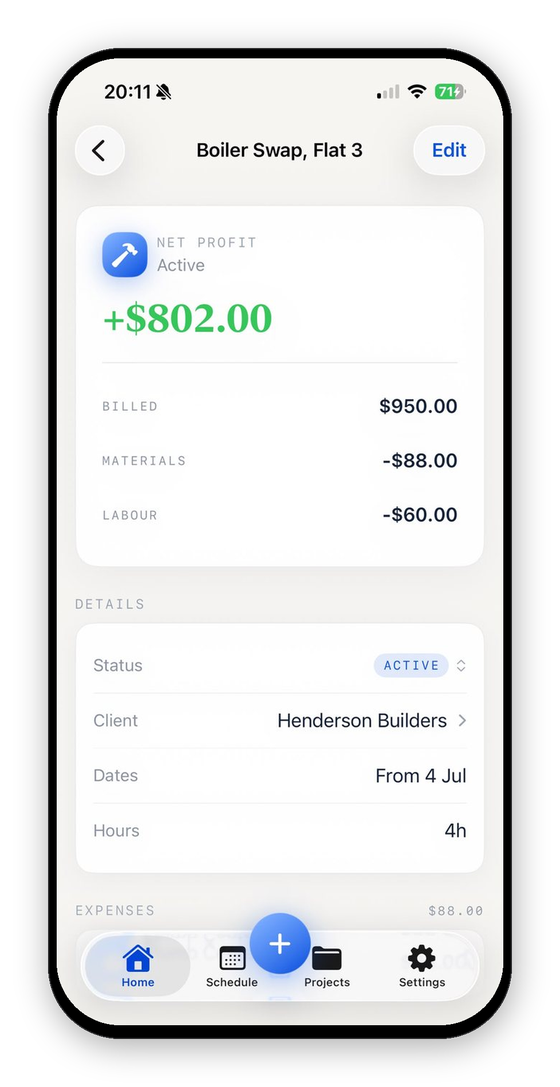
VanReceipts is built for exactly this: scan the supplier receipt and the fuel slip from the front seat, log mileage and time, and tag a callback to the original visit with one tap. Because every cost lands against the right job automatically, your real callback rate, your real cost per call, and your true billable hours are sitting there at month end instead of buried in a shoebox of receipts. For the fuller method on installs and the equipment side of HVAC work, see job costing for HVAC. For the general framework this builds on, start with the complete guide to job costing.
What did that job really make?Profit and margin for any job in seconds.FAQ
How much should I charge for an HVAC service call?
There is no single right number, because drive times, labor rates, and supplier costs differ by market and by business. The reliable way to set it is to cost your own visit: drive time, diagnostic time, a parts minimum, a refrigerant allowance, a callback reserve, and a slice of overhead, then price above that total.
What is a fair HVAC hourly rate?
It depends on your overhead, your desired profit, and how many hours a year you can actually bill, which vary by shop. Calculate it as (annual overhead plus desired profit plus technician wage and burden) divided by realistic billable hours, usually 1,200 to 1,500 hours a year for a solo or small-crew operation, rather than copying a number from a competitor whose costs are different from yours.
Should the diagnostic fee include refrigerant?
Budget an allowance for it even on calls where you do not expect to use it. Refrigerant is regulated, requires EPA 608 certification to handle, and its cost varies by blend and supplier, so a call that unexpectedly needs a top-up can erase a fee that only covered drive and diagnostic time.
How do I account for callbacks in my pricing?
Log every callback against the original visit so you can calculate your actual callback rate over a few months. Build a reserve into your service call price sized to that real rate, instead of guessing or ignoring it.
Does a flat-rate price book replace this kind of costing?
No, it complements it. A flat-rate book sets what you charge for a defined repair; costing tells you whether that price still clears a margin once drive time, refrigerant, and callbacks are counted. Check the book against real costs periodically rather than setting it once and leaving it.
Cost Your Next Service Call
Before you dispatch on the next no-cool call, write down what it actually costs you: the drive, the time, the parts minimum, a refrigerant allowance, a slice for callbacks. Compare that to your current fee, and check your hourly rate against your real overhead and billable hours while you are at it. If the gap is thinner than you expected, you now know exactly why, and exactly what to fix.
Download VanReceipts on the App Store and price your next HVAC service call from real numbers, not a guess.